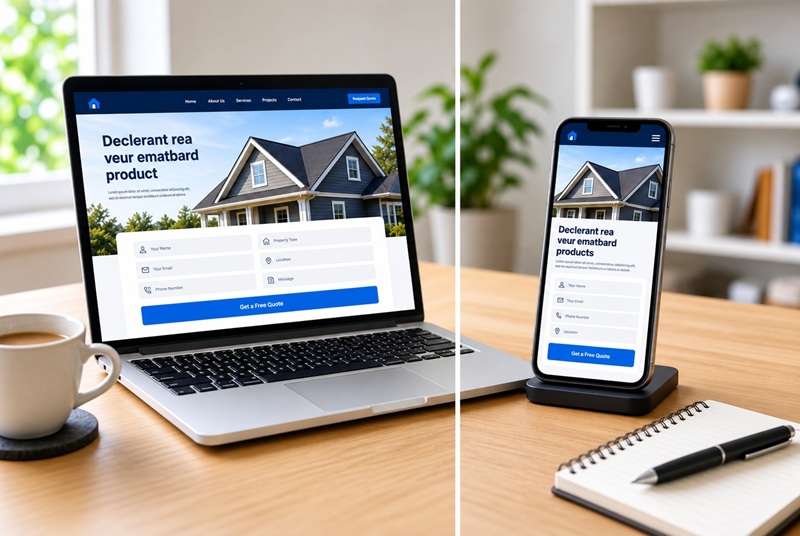
A roofing company in Texas was spending $3,200 a month on Google Ads, sending every click to their homepage. Their conversion rate sat at 1.2%. They didn’t change the ad, didn’t change the budget, they just built one dedicated landing page for that campaign with a clear headline, a visible phone number, and a single form. Conversion rate jumped to 4.8% within the first month. Same traffic, same offer, completely different result.
That’s what a landing page does when it’s built right. It’s not a design exercise, it’s the difference between someone leaving your site in 8 seconds or picking up the phone. Here are the five features that actually move the needle for roofing companies, not just the generic “have a nice website” advice you’ll find elsewhere.
1. A Hero Section That Answers “What, Where, Why You” in Five Seconds
Most visitors decide whether to stay or bounce before they even scroll. Your hero section has to answer three questions instantly: What do you do, where do you serve, and why should they trust you over the next roofer on Google.
A weak headline looks like this: “Welcome to ABC Roofing.” It says nothing. A strong headline looks like this: “Licensed Roofing Repairs & Replacements in Austin, TX, Free Estimates Within 24 Hours.”
Notice the difference. The second one includes the service, the location, and a specific promise. That’s what turns a cold visitor into someone who reads further instead of hitting the back button.
What to include in your hero:
- A headline that names the service and the city or region
- A subheadline with one specific trust element (licensed, insured, years in business, or a guarantee)
- A visible phone number and a primary CTA button, both above the fold
2. Trust Signals Placed Where People Actually Look
Homeowners are cautious about roofers, and rightly so, it’s an industry with a real scam problem after storms. Trust signals need to be visible without scrolling far, not buried at the bottom of the page.
The trust signals that actually influence decisions are specific, not generic:
- Real customer reviews with names and locations, not just a star rating graphic. “5 stars, verified reviews” means nothing without a name like “Reviewed by Sarah M., Round Rock TX” attached to it.
- License and insurance numbers stated directly, not just a badge icon that could belong to anyone.
- Before-and-after project photos from actual jobs, ideally with the neighborhood or city mentioned.
- Manufacturer certifications (like GAF Master Elite or CertainTeed SELECT ShingleMaster) if you have them, since these carry real weight with homeowners who’ve done a little research.
A badge that just says “Trusted Contractor” with no source behind it doesn’t build trust, it just adds visual clutter.
3. One Clear CTA, Repeated, Not Five Competing Ones
Here’s a mistake that quietly kills conversions: landing pages with too many choices. “Call Now,” “Get a Quote,” “Schedule Inspection,” “Learn More,” “Download Our Guide” all on the same page splits attention and makes visitors hesitate instead of act.
Pick one primary action, usually “Get a Free Estimate” or “Schedule an Inspection,” and repeat that same CTA at the top, middle, and bottom of the page. Keep the wording identical so there’s no confusion about what happens when someone clicks.
A good CTA button:
- Uses action language (“Get My Free Estimate” instead of just “Submit”)
- Stands out visually from the rest of the page (contrasting color, not blending into your brand palette)
- Appears at least three times on longer pages: top, after the trust section, and at the bottom
4. Local Proof, Not Just Local Keywords
Stuffing “roofing contractor in [city]” into your headline a few times isn’t local SEO, it’s keyword stuffing, and it doesn’t build trust with an actual visitor. Real local proof looks different:
- Mention specific neighborhoods, suburbs, or landmarks you’ve worked in, not just the city name.
- Reference local weather patterns relevant to roofing (hail season, humidity, snow load) to show you understand the region’s specific challenges.
- Embed a Google Map showing your service area or business location.
- Include a review or photo tied to a recognizable local project, if you have permission to share it.
This does two things at once: it helps with local search relevance, and it reassures the visitor that you’re not a national call center dispatching random subcontractors.
5. A Fast, Mobile-First Page With a Frictionless Form
More than half of roofing searches happen on a phone, often right after a storm when someone’s standing in their yard looking at damage. If your landing page takes more than 3 seconds to load or the form is clunky on mobile, you lose that visitor before they ever see your trust signals.
Practical fixes that matter here:
- Compress images so the page loads fast on mobile data, not just wifi.
- Keep the contact form short: name, phone, address, and a one-line description of the issue is usually enough. Every extra field drops completion rates.
- Make the phone number a tap-to-call link, not just plain text.
- Test the page on an actual phone, not just by shrinking your browser window. Things look different on a real device.
Weak Landing Page vs. Strong Landing Page
| Element | Weak Version | Strong Version |
|---|---|---|
| Headline | “Welcome to Our Roofing Company” | “24-Hour Storm Damage Repair in [City], Licensed & Insured” |
| Trust signals | Generic star icon graphic | Named reviews, license number, real project photos |
| CTA | 5 different buttons competing for attention | One repeated CTA: “Get My Free Estimate” |
| Local relevance | City name repeated in text | Neighborhood mentions, local weather context, embedded map |
| Mobile experience | Slow load, long form | Fast load, 4-field form, tap-to-call button |
Quick Audit Checklist
Run your current landing page through these six questions:
- Can a visitor tell what you do and where you work within 5 seconds, without scrolling?
- Are your reviews attached to real names and locations, not just a star rating?
- Is there one clear, repeated call to action, not several competing ones?
- Does the page load in under 3 seconds on mobile?
- Is your form short enough to complete in under 30 seconds?
- Does the page mention anything specific to your actual service area, beyond just the city name?
If you answered no to two or more of these, that’s likely where visitors are dropping off before ever contacting you.
FAQs
How long should a roofing landing page be?
Long enough to answer objections, but short enough that a mobile visitor doesn’t have to scroll endlessly before finding the CTA. Most effective roofing landing pages run 600 to 1,000 words with clear sections, not a single wall of text.
Should I send paid ad traffic to my homepage or a dedicated landing page?
A dedicated landing page almost always converts better for paid traffic, because it matches the exact offer or service the ad promised, without the distractions of a full homepage navigation menu.
Do I need video on my landing page?
It’s not essential, but a short video (30 to 60 seconds) showing the owner or crew introducing themselves can boost trust, especially for a local, independent contractor competing against bigger franchises.
What’s the single biggest mistake roofing landing pages make?
Too many competing CTAs and no specific local proof. Both create hesitation, and hesitation is what makes a visitor leave without contacting you.
How often should I update my landing page?
Review it every 3 to 6 months. Update seasonal offers, refresh testimonials, and make sure your license and insurance information is current.
The Bottom Line
A high-converting roofing landing page doesn’t need flashy design tricks, it needs clarity. Visitors need to know instantly what you do, where you work, and why they should trust you, and then they need one obvious next step to take. Fix those five areas and you’ll see the same kind of jump in conversions that comes from actually fixing the page, not just spending more on ads to send traffic to a weak one.
Author Bio:
Satendra Kashyap is a content writer at Roofing Cop with 5+ years of experience writing about roofing, home improvement, and contractor selection. He regularly researches local building codes and material standards to keep his guides accurate and genuinely useful for homeowners making major roofing decisions.